The Sierra y Mancha Conquense pilot
A Roman archaeological park, a historic pilgrim route and 56 municipalities: can heritage hold a depopulating territory together?
How does the Spanish pilot use cultural heritage, and what does its Regional Action Plan target by 2028?
It uses the Segóbriga Archaeological Park and the Camino de la Orden de Santiago as anchors for tourism, entrepreneurship and cooperation across the ADESIMAN territory. By 2028 the RAP targets 30 % growth in heritage-tourism receipts, population decline slowed to under 0.5 % a year, three smart-territory digital solutions, at least ten energy-community projects and sixteen community composters.
- Territory: the ADESIMAN area in Cuenca (Castilla-La Mancha), anchored on the Segóbriga Archaeological Park
- ADESIMAN, formed in 1997 from two local development groups, covers 56 municipalities
- RAP targets for 2028 include +30 % heritage-tourism receipts and population decline under 0.5 % a year
- Open calls: AI4RURAL ideathon in Tarancón; ARISE, a public platform linking heritage routes and local businesses
Sierra y Mancha Conquense (Cuenca), Spain: Segóbriga heritage as a development engine
main tellingexample world: spaindepth: standard3 min markdown
The Spanish pilot covers the territory of ADESIMAN, the Federation for the Development of Sierra and Mancha Conquense, in the province of Cuenca (Castilla-La Mancha). ADESIMAN was formed on 7 January 1997 by merging two local development groups, ADIMMAC and SEDECUCE. It covers 56 municipalities and has run development programmes such as PRODER 1 and 2. Its cultural anchor is the Segóbriga Archaeological Park, and the historic Camino de la Orden de Santiago route crosses the area.
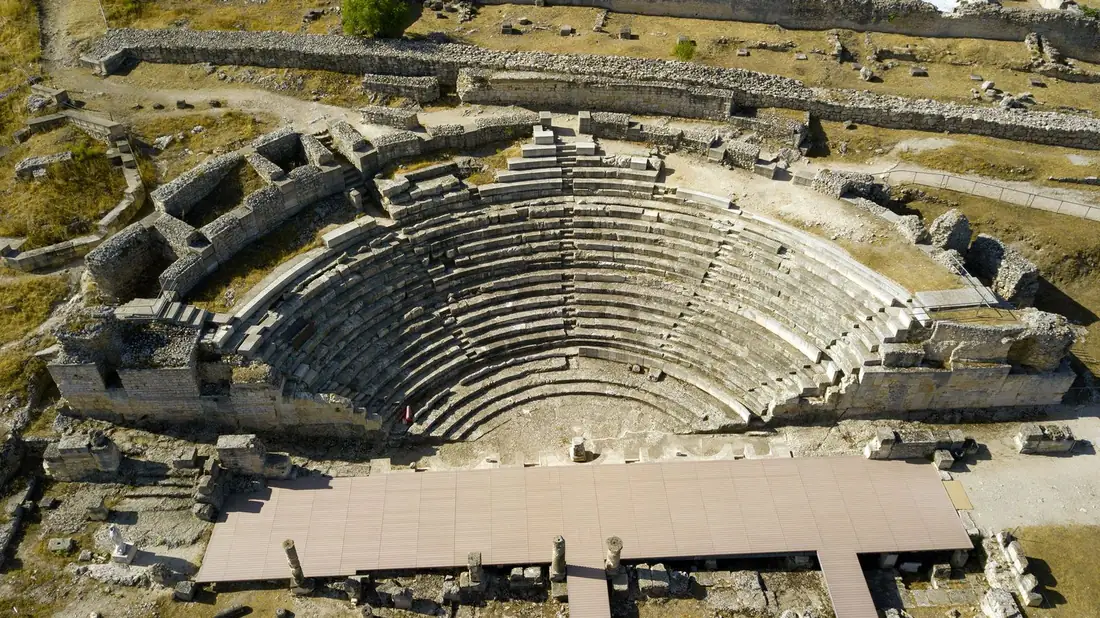
The Roman theatre of Segóbriga. Photo: PoliRuralPlus pilot materials (RP7), poliruralplus.eu
| Territory | ADESIMAN area, Sierra y Mancha Conquense, Cuenca |
| Partners | Fundación SocialInnoLabs, SINNO (lead); Plan4All, P4A (support); ADESIMAN co-authored the brief |
| Theme | Rural-urban synergies and cultural heritage |
| RAP | Sierra y Mancha Conquense territorial strategy, targets to 2028 |
| Open calls | Mobilise: AI4RURAL Ideathon (ITECAM). Develop: ARISE |
The challenge
The pilot wants to treat heritage, entrepreneurship, the digital transition and local capacity building as one agenda, not four. The brief lists depopulation, ageing and a male-dominated population; sparse broadband; heritage sites such as Segóbriga and Valeria without coordinated branding, digital integration or year-round visitor services; dependence on primary sectors; water scarcity and weak waste infrastructure; and fragmented governance and finance.
What the plan sets out
By 2028 the RAP targets 30 % growth in heritage-tourism receipts, population decline slowed to under 0.5 % a year, three smart-territory digital solutions, at least ten municipal energy-community projects and sixteen community composters. The brief recommends:
- a Rural-Urban Synergy & Cultural-Heritage Innovation Hub with a digital marketplace, immersive tourism apps and shared workspaces;
- an ADESIMAN Smart Territory programme linking four digitised archaeological and cultural sites by 2027;
- an €80 million Cultural Bio-Circular Fund (CAP-LEADER, ERDF, private capital) and a refundable 25 % tax credit for low-carbon agritourism and digital platforms;
- a network of rural service hubs (co-working, tele-medicine, e-mobility) in every town above 500 inhabitants by 2028;
- five certified courses for at least 100 participants.
Tools, open calls and status
The AI4RURAL Ideathon (Mobilise), run by ITECAM in Tarancón, brought together about thirty professionals, start-ups and local actors to develop AI-based ideas for smart tourism, heritage, environmental management and local services. ARISE (Archaeological Routes for Inclusive Synergy & Entrepreneurship; Develop), led by the Obsidian Innovation Institute with Xilbi Sistemas de Información, produced a public digital platform that links archaeological heritage, cultural routes and local tourism services. It includes a business directory and an AI guide.
ARISE is the pilot’s working output. The hub, the fund and the service network are proposals. D7.4 adds an “EDIL” governance platform and AI-based tourism and energy modelling to the expected results.
Related
- Builds on: The network of nine pilots
- Leads to: ARISE heritage platform (Cuenca)
Sources
- D7.3 Policy Brief No. 1, Annex 7 "Revitalising Rural–Urban Synergies and Cultural Heritage in Sierra y Mancha Conquense, Spain". PDF
- D5.1 Prepared pilot by Stakeholder Multi-Actor Approach, §2.7 "Spain". PDF
- D7.4 Exploitation plans and business models, edition 1, §3 Table 10. PDF
- D6.3 Comprehensive Report on Funded Activities and Impact Assessment (AI4RURAL, ARISE). PDF
- PoliRural+ website, pilot page "Spain – Sierra and Mancha Conquense / Segobriga" (2024 and 2026 texts). poliruralplus.eu