The Malta and Gozo pilot
Farms usually under one hectare, a workforce mostly over 45, young people leaving: why Malta's plan picks small enabling steps over big reforms.
Why does the Malta RAP choose small enabling actions over structural reform, and what are those actions?
The barriers are skills, confidence, small scale and fragmented support among smallholders, so the RAP starts where farmers are. It proposes hands-on digital demonstrations, low-barrier skills training, guidance to existing funds, peer learning through local champions, and youth innovation events such as the MaYA ideathon.
- Agricultural labour force fell 26.7 % between 2010 and 2020; only 23.7 % of farm workers are under 45
- Average farms are under one hectare, and Malta relies heavily on imported fresh food
- The RAP deliberately chooses enabling actions (training, demonstrations, informal dialogue) over structural reform
- Open calls: AgriFusion stakeholder research, the MaYA Agri-Tech Ideathon, the MALTESE Develop project
Malta and Gozo: digital and business skills for a shrinking farm workforce
main tellingexample world: maltadepth: standard3 min markdown
Malta is the smallest EU country, 313 km², and with Gozo it forms a very compact rural-urban system. Agriculture competes there with scarce land, scarce natural resources and development pressure, yet it still shapes the islands’ landscape and food culture.
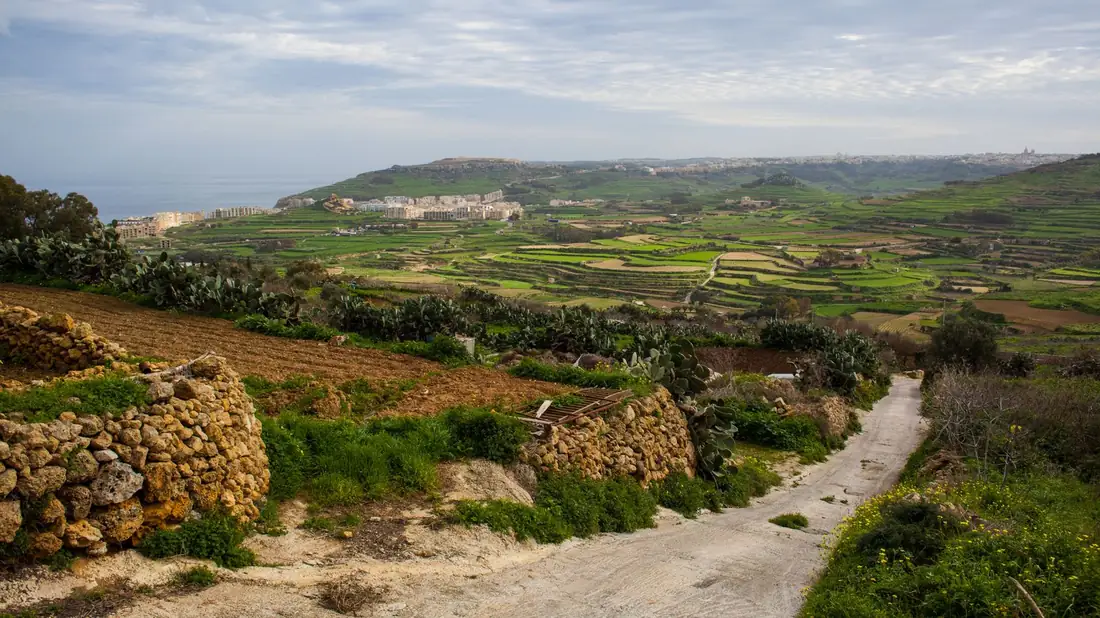
Terraced fields on Gozo. Photo: PoliRuralPlus pilot materials (RP9), poliruralplus.eu
| Territory | Malta and Gozo |
| Partner | AcrossLimits, AL (lead; the only partner) |
| Theme | Digital transformation and entrepreneurship in agriculture, with a focus on young people |
| RAP | Malta RAP, version 1 (2025) |
| Open calls | Outreach: AgriFusion (The Veg Box). Mobilise: MaYA Agri-Tech Ideathon. Develop: MALTESE |
The challenge
The numbers explain the urgency. The agricultural labour force fell by 26.7 % between 2010 and 2020. In 2022 there were only 1,200 registered young farmers under 40, and only 23.7 % of agricultural workers are under 45. Average farms are under one hectare, insecure tenure discourages investment, and the islands depend heavily on imported fresh food. Young people see farming as outdated and economically unviable and leave for towns or other EU countries. Smallholders know little about digital tools such as IoT, CRM or e-commerce and have little access to training.
What the plan sets out
The RAP chooses enabling actions rather than large structural reforms. By 2028 it aims to help make locally produced food more visible and easier to sell, build digital and business skills among rural actors, and involve young people in agri-food value chains. The brief recommends:
- informal, hands-on demonstrations of digital tools (IoT, traceability, e-commerce) in Malta and Gozo;
- low-barrier training in digital literacy and online marketing for farmers, young people and rural SMEs;
- guidance to existing schemes such as Digitalise Your SME, CAP eco-schemes and Business Enhance;
- peer-led learning on hydroponics, composting and smart water use;
- youth innovation events, building on the MaYA ideathon;
- roundtables, local champions, and simple summaries of EU tools such as the MAA Tool (see the multi-actor approach).
Open calls and status
AgriFusion (Outreach) researched stakeholder views on sustainable agriculture and food security, and the RAP draws on it. The Malta Youth in Agriculture Foundation ran the MaYA Agri-Tech Ideathon (Mobilise). The Develop project MALTESE (Malta Agro-Leadership & Tech Entrepreneurship for Sustainable Empowerment), led by an Austrian organisation with Maltese and Hungarian partners, plans agro-leadership training, a localised AI assistant and an e-marketplace. The pilot web page lists no results yet. By its own description the RAP is modest in scale, a deliberate fit for an island of smallholders.
Related
- Builds on: The network of nine pilots
Sources
- D7.3 Policy Brief No. 1, Annex 9 "Transforming Malta's Agri-Food System through Digital Innovation and Circularity". PDF
- D5.1 Prepared pilot by Stakeholder Multi-Actor Approach, §2.9 "Malta". PDF
- D6.3 Comprehensive Report on Funded Activities and Impact Assessment (AgriFusion, M-ATI, MALTESE). PDF
- PoliRural+ website, pilot page "Malta – Malta and Gozo" (2024 and 2026 texts). poliruralplus.eu