The County Monaghan pilot
How a rural Ulster county turned low awareness of the circular economy into a 2026–2030 action plan with two hubs.
What three interventions does the County Monaghan Regional Action Plan set out, and how far has each got?
A Regional Circular Economy Hub, circular waste-to-resource systems, and a community energy transition. The circular-economy hub is proposed; the Community Energy Engagement Hub has moved furthest, into follow-on projects such as a community hydro initiative in Inniskeen.
- Theme chosen with stakeholders: from green-economy jobs (2024) to a circular-economy RAP for 2026–2030
- Barriers: low awareness, fragmented finance (LEADER, SEAI, ERDF in silos), too little anaerobic digestion and composting capacity
- Policy brief: a national network of Circular Economy Innovation Hubs, starting with a flagship in Monaghan
- The pilot's Rural Circular Economy Funding Business Model is listed on the EU Innovation Radar
County Monaghan, Ireland: a circular-economy plan for a border county
main tellingexample world: irelanddepth: standard3 min markdown
County Monaghan is a predominantly rural border county in Ulster, with dispersed settlements, a strong agri-food sector and close ties to Northern Ireland. The 2016 census counted 61,386 residents, only 37 % of them living in urban areas.
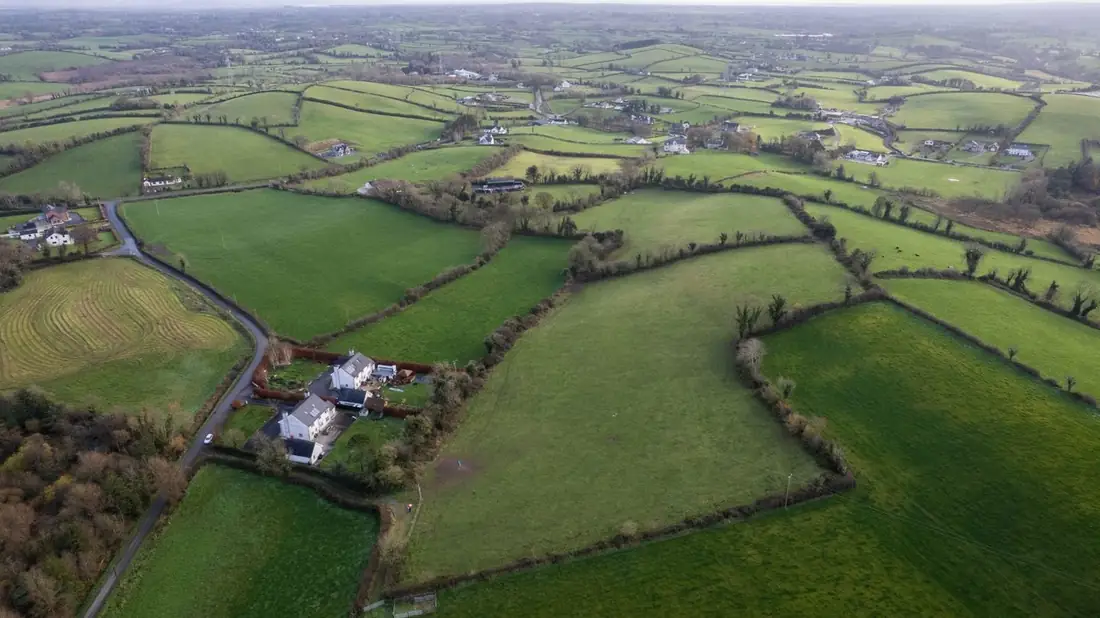
Drumlin farmland in County Monaghan. Photo: PoliRuralPlus pilot materials (RP1), poliruralplus.eu
| Territory | County Monaghan (Border Region, Ulster) |
| Partners | Monaghan Integrated Development, MID (lead); MAC, National Microelectronics Applications Centre (technical support) |
| Theme | Circular economy and community energy |
| RAP | “Circular Economy in Co. Monaghan”, roadmap 2026–2030 |
| Open call | Outreach: circular-economy scoping study (MCA Consulting) |
From green economy to circular economy
In 2024 stakeholders weighed three themes (green-economy entrepreneurship, sustainable tourism, dairy innovation) and chose the green economy (D5.1). The work then narrowed to the circular economy. The barriers the pilot names are low awareness, weak collaboration between businesses, communities and public bodies, fragmented finance (LEADER, SEAI and ERDF funding run in silos), skills gaps, youth outmigration, and too little anaerobic-digestion and composting capacity for the agri-food sector’s organic residues.
What the plan sets out
The RAP has three interventions:
- a Regional Circular Economy Hub, a focal point for SMEs, farmers, community groups, public bodies and education partners, offering training, mentoring, access to funding, and repair and reuse activities;
- circular waste-to-resource systems;
- a community energy transition, carried by a Community Energy Engagement Hub developed with the county’s Sustainable Energy Community network.
The policy brief (June 2025) scales this up nationally: a network of Circular Economy Innovation Hubs starting with a flagship in Monaghan, a refundable 20 % R&D tax credit for certified circular products, capital grants for on-farm anaerobic digestion and biochar, a national waste-mapping portal, and more LEADER funding for circular pilots. The brief states that the RAP’s findings point to at least 30 % waste reduction and about 250 green jobs from this policy mix.
Where things stand
The scoping study, funded through the Outreach open call, is complete. Its ideas workshop, run with Monaghan County Council, fed directly into the RAP. The Circular Economy Hub is proposed, with MID, the County Council and LEO Monaghan as the basis for keeping it going after the project. The energy hub has moved furthest: follow-on work includes “Harnessing Hydro Power for Our Community” with Inniskeen Enterprise Development Group. The pilot’s Rural Circular Economy Funding Business Model is listed on the EU Innovation Radar. D7.4 suggests overlaying local datasets (CSO statistics, county development plans) in JackDaw; that is a suggestion, not a reported result.
Monaghan shows the pattern most pilots share: build the evidence, then propose a hub to hold the coalition together.
Related
- Builds on: The network of nine pilots
Sources
- D7.3 Policy Brief No. 1, Annex 1 "Advancing the Circular Economy in Ireland". PDF
- D5.1 Prepared pilot by Stakeholder Multi-Actor Approach, §2.1 "County Monaghan, Ireland". PDF
- D7.4 Exploitation plans and business models, edition 1, Annex A §4 "Ireland / Monaghan County". PDF
- PoliRural+ website, pilot page "Ireland – County Monaghan" (2024 and 2026 texts). poliruralplus.eu
- EU Innovation Radar, Rural Circular Economy Funding Business Model. innovation-radar.ec.europa.eu/innovator/898902493