The Mallusjoki pilot
A youth association in a southern Finnish village plans to turn cultural events into a development engine that draws visitors from Lahti and Helsinki.
What is the Mallusjoki pilot building, and what does its Regional Action Plan aim for by 2028?
A Rural Event Industry Ecosystem: culture-led events that attract urban visitors and create local work. By 2028 the RAP aims for twelve annual festivals with 10,000 visitors, 30 % more rural SMEs linked to creative tourism, and a carbon-neutral main venue, tied to renovating the Green Cultural Centre.
- The smallest territory in the network: one village in Orimattila, led by the local youth association (MYA)
- More than 1,000 people involved and a 23-member stakeholder panel
- RAP targets for 2028: twelve festivals a year, 10,000 visitors, a carbon-neutral main venue
- Brief: a Rural Event Innovation Hub and a partnership with Orimattila, Lahti and Helsinki
Mallusjoki, Finland: a village building a rural event industry
main tellingexample world: finlanddepth: standard3 min markdown
Mallusjoki is a village in the municipality of Orimattila, in the Päijät-Häme region of southern Finland, with Lahti as the nearest city. It is seen as typical of Finnish villages: farmland, community traditions and long-running cultural events. A model that works here could be repeated elsewhere.
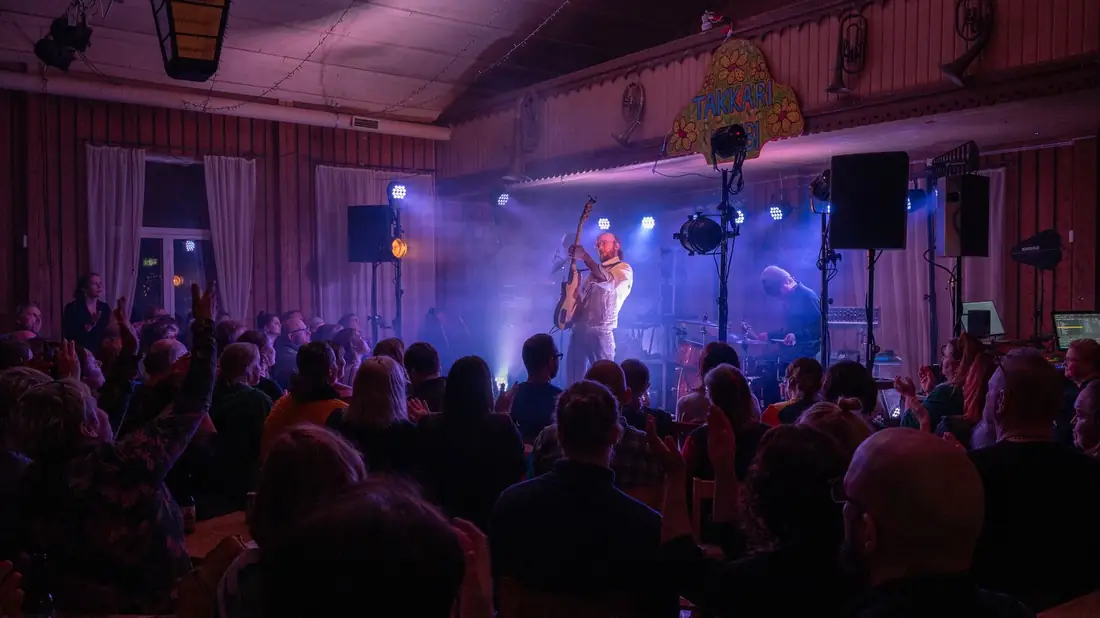
A village concert: the rural event industry of Mallusjoki. Photo: PoliRuralPlus pilot materials (RP5), poliruralplus.eu
| Territory | Mallusjoki village, Orimattila, Päijät-Häme |
| Partners | Mallusjoki Youth Association, MYA (lead); Smart & Lean Hub, SML |
| Theme | Rural Event Industry Ecosystem: tourism from cities to the countryside |
| RAP | Mallusjoki RAP, with the Rural Event Industry Strategy 2040 |
| Open calls | Mobilise: Go Mallusjoki! (Avoin Ry). Develop: Avoin-Map (Avoin Map Oy) |
The challenge
The pilot wants to turn cultural events into a long-term development engine that builds jobs, skills and self-confidence and brings in urban visitors. It has grown into an ecosystem of more than 1,000 people, with a 23-member stakeholder panel. The brief names the obstacles: an ageing population and volunteer fatigue, a 100-year-old clubhouse that needs renovation, visitors concentrated in summer, scarce last-mile transport and accommodation, low use of digital marketing and ticketing, and slow permits and finance.
What the plan sets out
The main deliverable is the Rural Event Industry Strategy 2040 for the youth association, with a vision, a roadmap and an action plan. By 2028 the RAP aims for twelve annual festivals attracting 10,000 visitors, a 30 % rise in rural SMEs linked to creative tourism, and carbon-neutral operation of the main venue. The brief recommends:
- a Mallusjoki Rural Event Innovation Hub with a digital marketplace, AI-driven ticketing and one-stop advice;
- three regional AKIS knowledge hubs and twenty certified advisers in event logistics, digital marketing and sustainable tourism by 2027;
- a €40 million Rural Creative Infrastructure Fund (LEADER, Interreg, private capital) to renovate the Green Cultural Centre, add renewable micro-grids and expand accommodation;
- zero-waste certification of events by 2030;
- a partnership agreement with Orimattila, Lahti and Helsinki on marketing, transport and cultural exchange.
Tools, open calls and status
The Go Mallusjoki! ideathon (Mobilise) produced 51 event and service concepts. Participants showed high acceptance of AI in regional development, and the ideas fed into the RAP. The Develop project Avoin-Map is building open-source energy, zoning and activity maps and helped co-design the Green Cultural Centre. Technical pilots add a Story Pathways editor (local stories as mapped routes) and a ServQual app for service gaps at events.
The strategy and the RAP are published pilot results. The hub, the fund and the city partnership are still recommendations.
Related
- Builds on: The network of nine pilots
- Leads to: Avoin-Map spatial tools
Sources
- D7.3 Policy Brief No. 1, Annex 5 "Developing a Rural Event Economy in Mallusjoki, Finland". PDF
- D5.1 Prepared pilot by Stakeholder Multi-Actor Approach, §2.5 "Mallusjoki, Finland". PDF
- D7.4 Exploitation plans and business models, edition 1, Annex A §2 "Finland – Päijät-Häme Region". PDF
- D6.3 Comprehensive Report on Funded Activities and Impact Assessment (Go Mallusjoki!, Avoin-Map). PDF
- PoliRural+ website, pilot page "Finland – Mallusjoki" (2024 and 2026 texts). poliruralplus.eu